The question
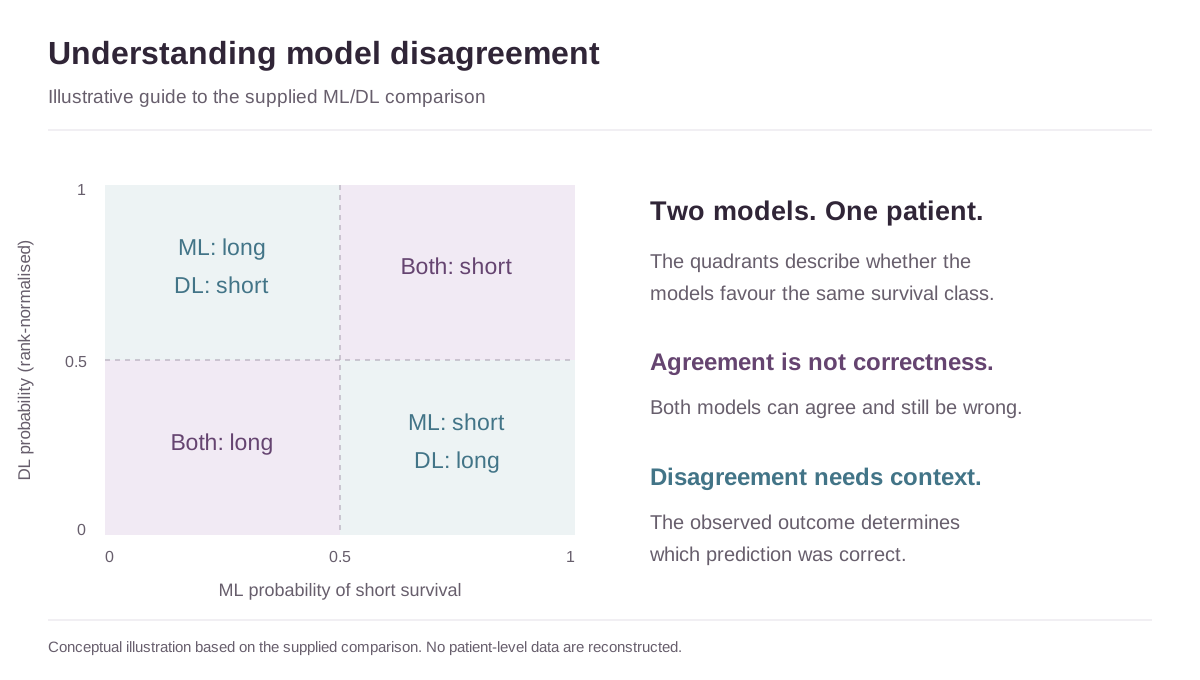
Radiomic machine learning and deep learning can disagree on the same patient. This research asks whether their predictions can be combined according to how decisive each model is.
The approach
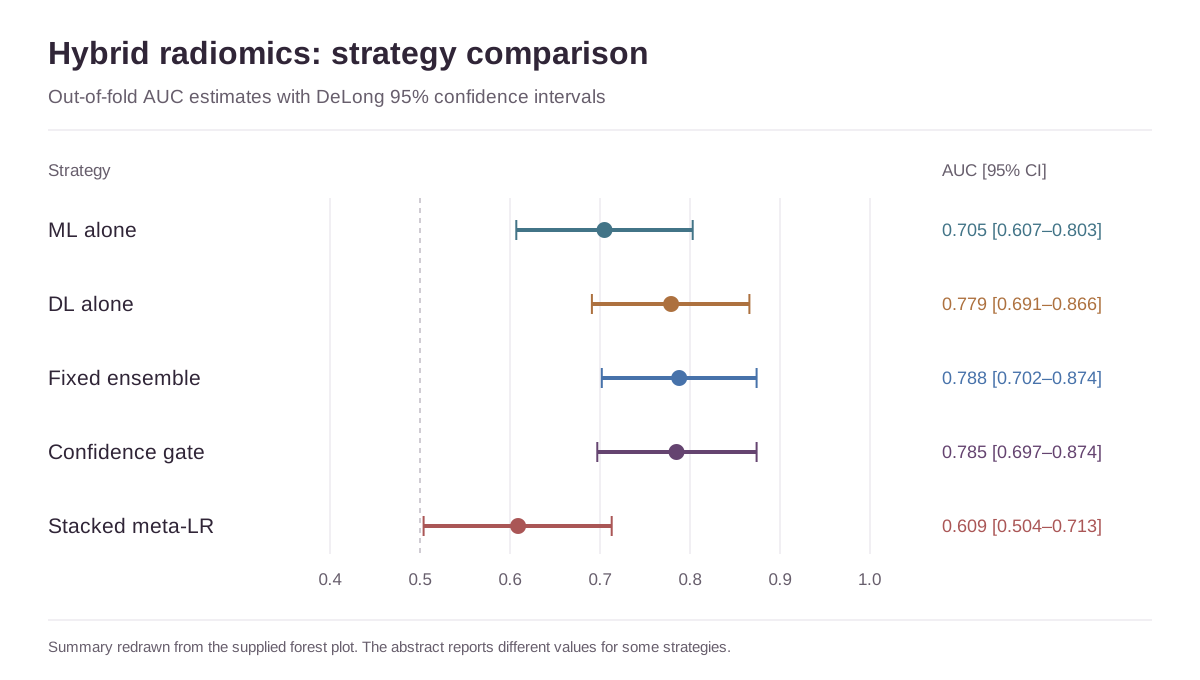
This retrospective study used only the BraTS-PEDs 2024 public dataset: 113 subjects with complete multiparametric MRI and overall survival data. It compared radiomic machine learning, FLAIR-based deep learning, fixed-weight ensembles, per-patient confidence gating and stacked logistic regression. The confidence gate weights predictions according to each model’s decisiveness rather than withholding predictions.
What we know
Confidence gating achieved an AUC of 0.793, compared with 0.787 for deep learning alone. The improvement was modest and not statistically significant.
What remains open
The retrospective cohort contained 113 subjects. Aggregate ensemble improvements were not statistically significant. Subgroup findings require independent validation before informing clinical decisions.
- How should model confidence affect ensemble weighting?
- How well do subgroup findings generalise?
- Does the ensemble improve on deep learning alone?
RSNA abstract
Hybrid radiomics and deep learning with confidence gating for survival prediction in pediatric high grade gliomas
Lakshmi Kaza, MBBS; Shreyas Reddy Kankara, MD, MBBS; Divya Buchireddygari, MD; Gadha Lekshmi P
Purpose
This study aimed to evaluate whether a confidence-gated hybrid ensemble of radiomic machine learning (ML) and deep learning (DL) improves overall survival (OS) prediction in paediatric high-grade gliomas, and to characterise patient subgroups in which each model should be preferentially weighted.
Methods and materials
This retrospective study included 113 subjects from the BraTS-PEDs 2024 public dataset with complete multiparametric MRI and OS data (median OS 397 days; binary label: OS ≤397 days = short survival). The ML arm used K-nearest neighbour classification, optimised via five-fold nested cross-validation, with FDR-selected radiomic features (cap=20) and seven clinical variables. The DL arm used a 3D squeeze-excitation ResNet trained on FLAIR with a Cox partial likelihood loss function. The strategies compared were ML alone (A), DL alone (B), fixed-weight α-sweep (C), per-patient confidence gating weighted by decisiveness |p−0.5| (D), and stacked logistic regression (E). OOF AUC values with DeLong exact 95% CIs were computed per STARD guidelines.
Results
ML alone: AUC 0.705 (95% CI: 0.607-0.803); DL alone: 0.787 (0.702-0.872). The fixed ensemble (α=0.45) and the confidence gate yielded AUCs of 0.789 (0.705-0.874) and 0.793 (0.708-0.877), representing modest, non-significant increments of +0.002 and +0.005 over DL alone. The stacked meta-learner underperformed both single models (AUC 0.690). DL confidence exceeded ML confidence in 65% of patients; in high-disagreement cases, DL was correct in 76% versus 41% for ML. The optimal ensemble weight (α=0.45) indicated roughly equal model contributions overall. Subgroup analysis revealed ML superiority only in patients under 8 years (AUC 0.718 vs. 0.696, Δ=−0.023); DL dominated all other subgroups, most markedly in older patients (≥8 years: AUC 0.832 vs. 0.675, Δ=+0.158) and on 3T scanners (AUC 0.793 vs. 0.655, Δ=+0.138).
Conclusions
Aggregate ensemble gains over DL alone were modest and non-significant; however, subgroup and disagreement analyses reveal actionable structure. DL should be preferentially weighted in patients aged ≥8 years and imaged on 3T scanners, while ML retains independent value in younger patients. The confidence gate operationalises this weighting per patient without requiring subgroup labels at inference time.
Clinical relevance/application
This hybrid framework provides interpretable, patient-level guidance on when to defer to FLAIR-based deep learning versus clinical-radiomic ML for survival stratification in paediatric high-grade gliomas. This guidance complements aggregate performance metrics and supports individualised treatment planning in a population with limited validated prognostic tools.