The question
A model can learn patterns specific to the scanner or acquisition process as well as patterns related to disease. A feature that looks useful in one setting may shift when imaging conditions change.
The approach
In 113 BraTS-PEDs subjects, the study compared 153 topological features with 428 radiomic features. Acquisition sensitivity was assessed using the partial variance attributable to scanner vendor and field strength after accounting for tumour volume.
What we know
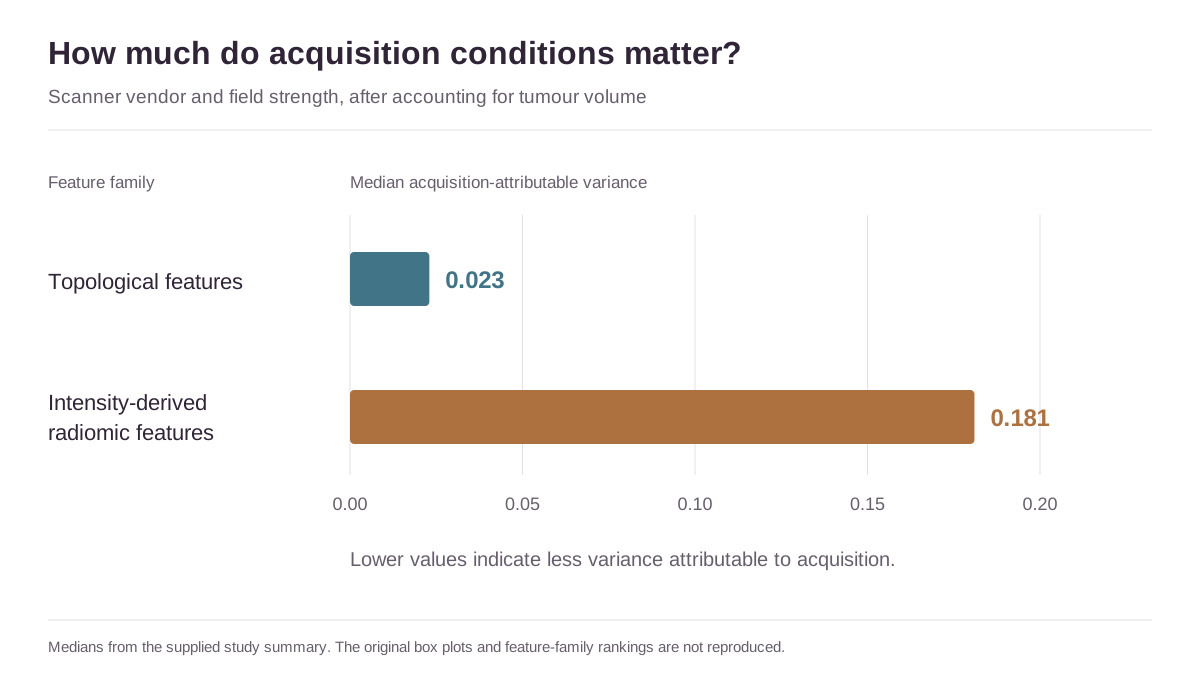
Median acquisition-attributable variance was 0.023 for topological features and 0.181 for intensity-derived radiomic features. Topological descriptors and mask-derived shape features were comparably robust.
What remains open
Scanner vendor was confounded with contributing institution. Robustness did not establish prognostic usefulness: neither feature family added overall-survival prognostic value over clinical variables at this sample size.
- Which acquisition changes were evaluated?
- How is stability measured?
- Does a stable feature remain clinically informative?
RSNA abstract
Topological descriptors show reduced acquisition sensitivity compared with radiomic features in pediatric high-grade glioma
Lakshmi Kaza, MBBS
Purpose
Radiomic analysis of preoperative MRI has shown potential for survival prediction and subclassification in glioma. Translation has been limited by the sensitivity of radiomic features to acquisition heterogeneity, which degrades performance across sites. Topological descriptors from persistent homology carry theoretical stability that radiomic features lack. This study compared the acquisition sensitivity of both families in a multi-institutional pediatric high-grade glioma cohort and tested whether either carried prognostic signal for overall survival.
Methods and Materials
113 BraTS-PEDs subjects with whole-tumor segmentations and acquisition metadata were analyzed. 153 topological features were extracted, comprising H0 and H1 persistence summaries and persistent Laplacian spectral statistics across 12 scales, alongside 428 PyRadiomics features across four sequences. Acquisition sensitivity was the partial R² of scanner vendor and field strength over and above log tumor volume, with a secondary model substituting slice thickness. Vendor is confounded with contributing institution, which tumor volume was included to attenuate. Group medians were compared by permutation test. Prognostic value was assessed by univariate Spearman association with overall survival under Benjamini-Hochberg correction, and by repeated 5-fold cross-validated penalized Cox models with in-fold feature selection.
Results
Median acquisition-attributable variance was 0.023 for topological features and 0.181 for intensity-derived radiomic features (permutation p<0.0001). No topological feature exceeded a partial R² of 0.122, whereas 44.9% of intensity-derived radiomic features exceeded 0.20, with native T1 first-order statistics highest at a family median of 0.428. Among topological families, H1 persistence summaries were most robust (0.010) and persistent Laplacian spectral features least (0.033). No feature of either family reached significance for overall survival after correction.
Conclusions
Acquisition sensitivity in this cohort was driven by dependence on absolute signal intensity. Topological descriptors and mask-derived shape features were comparably robust, while intensity-derived radiomic features showed scanner dependence. Neither family added prognostic value for overall survival over clinical variables at this sample size.
Clinical Relevance/Application
Multi-site imaging models built on intensity-derived radiomic features inherit substantial scanner dependence, with nearly half of such features attributable more to acquisition than to biology. Topological descriptors offer intensity-independent characterization of tumor structure at comparable robustness to shape features, without requiring harmonization.